Quiet Celebrations: How To Build Meaningful Moments During Difficult Seasons
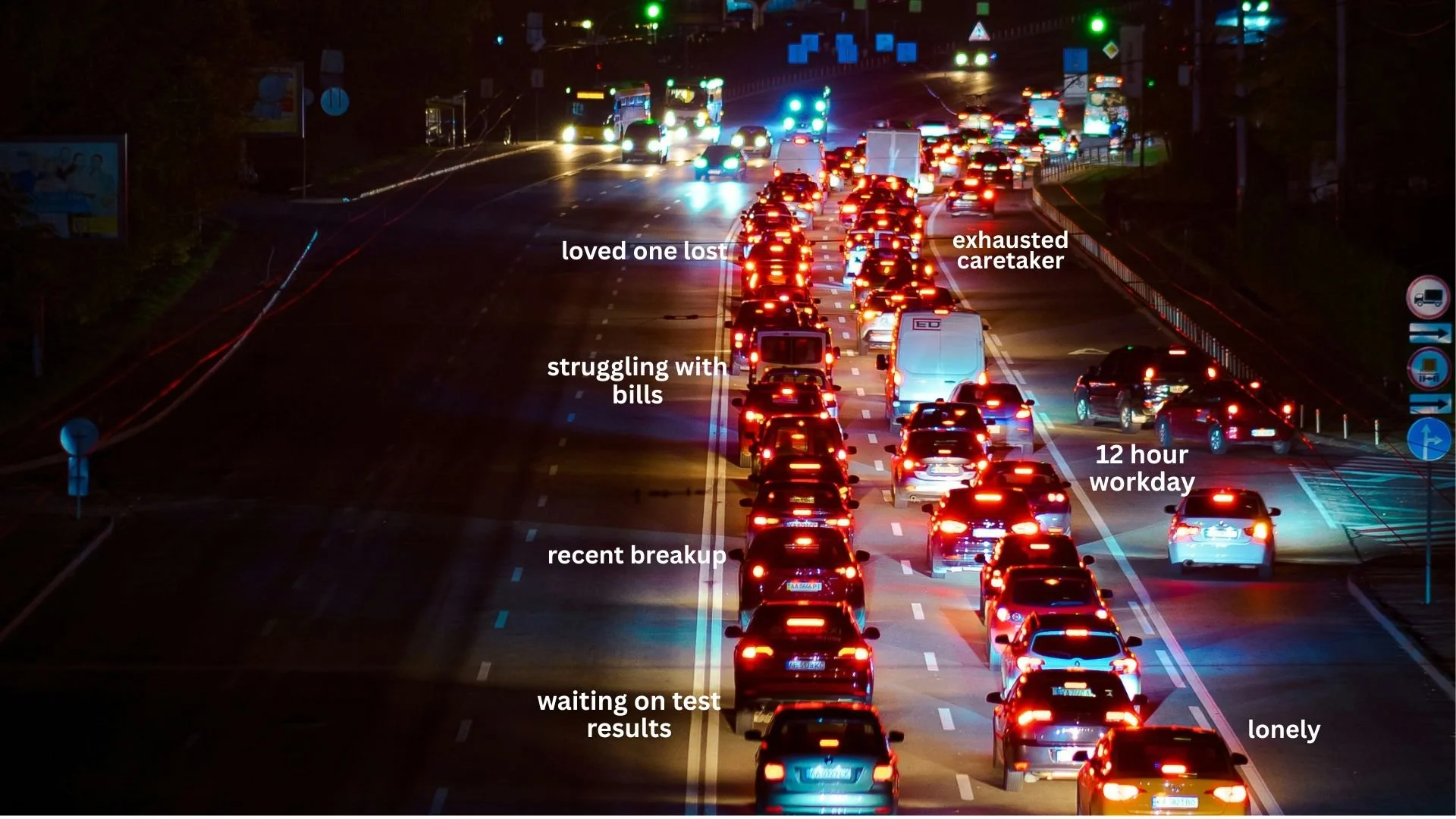
This past week, a conversation about grief surfaced - one of those unexpected, quiet pivots that suddenly pulls people into depth that surpasses “things have been great, just busy”. Everyone had experienced grief’s effect in some form. What struck me wasn’t just the shared loss, but the wildly different timelines and coping styles. Some were still in the deep end of fresh grief, every memory sharp and loud. Others spoke with more confidence, evidence of how grief complexly can soften with time, but still be undeniably present. I left the conversation reminded of how relentless grief can feel when it’s new, and simultaneously moved by the resilience of those who have been forced to live alongside it.
And it made me think about the holidays.
My own father passed nine years ago in November, right before the season of “high spirits”. I remember watching others around me continue on with their lives, excited for the upcoming moments of joy while I stared at a plate of cheesecake wondering how I could ever eat it again – when he wouldn’t be able to.
Holidays have a way of assuming how we feel - bright, social, grateful, “on.” But grief and loss, exhaustion, and burnout don’t abide by the calendar. They don’t pause because the world strings up lights and turns up the volume. They come with us, honest and unedited. What about the ones who are simply not in a celebratory season?
Any therapist knows, this is a difficult time of year for many. With expectations, societal pressure and the glitter we see on social media demanding jolly and bright energy…some are also struggling with the feeling of:
“I just don’t have it in me this year.”
When we’re grieving, burned out, or carrying emotional heaviness, our internal capacity shrinks. Not because we’re weak, but because grief and chronic stress require a lot of space. Research consistently shows that both grief and prolonged stress narrow emotional bandwidth, making overstimulation, forced cheer, and packed schedules feel even more overwhelming (cue Clark Griswold hitting his limit then cutting off the staircase bolster) (Bonanno, 2004; McEwen, 2017).
In case anyone is looking for some validation or relatability, here it is: you’re allowed to drop it all. If this round needs to be a season of quiet celebrations, or none at all - holidays shaped around gentleness, honesty, and grounding rather than performance or pressure…it’s okay.
When Holidays Collide with Grief or Burnout
Whether we’re grieving a person, a relationship, or simply the energy/excitement we used to have, the holidays tend to amplify what’s already bubbling underneath. Our body often speaks before our mind catches up.
We might notice:
Feeling detached or “far away” in social settings.
Noise and crowds becoming quickly overwhelming.
Emotional numbness or lowered motivation.
Sudden waves of sadness, irritability or anger, or fatigue.
A desire to withdraw, simplify, or be alone.
This is not us “being difficult”.
This is the nervous system doing its job under strain.
Neuroscience shows that grief and chronic stress activate the brain’s threat response (particularly the amygdala), while reducing the resources that support joy, social engagement, and ease (O’Connor et al., 2008). Burnout similarly blunts reward pathways, making things that used to feel good land more softly - or not at all (Maslach & Leiter, 2016).
In other words:
When our inner world is heavy, outside celebration can feel like too much…or sometimes make us feel nothing at all.
Quiet Celebrations: A Gentler Way to Move Through the Season
Quiet celebrations aren’t about opting out of meaning and connection.
They’re about right-sizing it - choosing small, steady moments over large, demanding ones.
They make room for grief, exhaustion or overwhelm while still allowing connection and comfort.
Here are a few ways to build holidays that fit your capacity right now:
1. Choose Depth Over Quantity
We don’t need to attend every gathering or say yes to every invitation.
Choosing one or two moments that feel nourishing to decrease overwhelm.
This might look like:
A slow dinner with someone who understands our season looking different.
A simple walk with a friend.
Lighting a candle for someone we miss.
Prioritizing rituals at home and opting out of the big family gathering this year.
Why it helps:
Low-pressure connection calms the nervous system and supports emotional resilience during grief (Stroebe & Schut, 2010).
2. Create Rituals That Honor Grief
Grief doesn’t disappear for the holidays. And as many know, it can often amplify it.
Rituals help give it shape and a small sense of purpose, which is important during times we feel out of control.
Try:
Writing a letter to the person you’re missing.
Cooking or eating something that reminds you of them.
Donating in their honor.
Why it helps:
Rituals help the brain process loss and maintain a sense of ongoing connection (Norton & Gino, 2014). It’s okay if this is too much, every time we think of someone we lost we are honoring our experience with them through memory...practical or concrete displays aren’t a requirement to healing.
3. Build Sensory-Friendly Moments
Holidays can be loud-visually, emotionally, socially. When we are struggling just to get by, the added sense of needing to present or show up in a certain way can make holiday moments feel impossible.
Consider gentle alternatives:
Planned breaks at holiday gatherings, or scheduled “things to do” that make sneaking off to take quiet space easier.
Music that soothes rather than stimulates.
Getting out in nature instead of heading to busy stores or malls.
Why it helps:
Lowering sensory input decreases cortisol and allows the nervous system to shift out of survival mode (Ulrich et al., 1991). When our internal capacity is maxed out, limiting the amount of “doing the most” we allow in can become necessary.
4. Let Rest Be a Celebration
Rest is not avoidance. It’s repair.
There are times the body and brain need just the basics. We might need more sleep, more unscheduled plans, quieter moments, more compassion and understanding, a conversation expressing to someone we trust “this season is hard right now”.
Why it helps:
Downtime restores emotional and cognitive resources depleted by burnout and grief (Sonnentag, 2018).
While some restructuring for rest and recovery is helpful, research also shows that having strong social support buffers the painful effects of grief and chronic stress (Taylor, 2011).
A Holiday That Fits Right Now
As someone years down the road from the initial sting of grief, in my experience – it will shift and change. Whether its grief, burnout, chronic stress or exhaustion weighing us down - being honest about the experience in the moment and allowing ourselves to let go of expectation, is a helpful survival tool. There is no right or wrong ‘morality’ to what we feel or think. With all the pressure holidays can bring, even on a good year, it is important we advocate for the season we are in now. Allowing what we want/need to be what it is in the moment helps us transition through. Being honest with ourselves and others is important to help a difficult season flow and pass.
If you're moving through grief, burnout, or emotional exhaustion this season, you don’t have to navigate it alone. Counseling can help us understand our emotional landscape, set boundaries that protect energy, and create rituals that honor where we truly are - not where we feel obligated to be.
We all deserve a season that meets us gently.
Resources:
Bonanno, G. A. (2004). Loss, trauma, and human resilience: Have we underestimated the human capacity to thrive after extremely aversive events? American Psychologist, 59(1), 20–28. https://doi.org/10.1037/0003-066X.59.1.20
Maslach, C., & Leiter, M. P. (2016). Burnout. In G. Fink (Ed.), Stress: Concepts, cognition, emotion, and behavior (pp. 351–357). Academic Press.
McEwen, B. S. (2017). Neurobiological and systemic effects of chronic stress. Chronic Stress, 1, 1–11. https://doi.org/10.1177/2470547017692328
Norton, M. I., & Gino, F. (2014). Rituals alleviate grieving for loved ones, lovers, and lotteries. Journal of Experimental Psychology: General, 143(1), 266–272. https://doi.org/10.1037/a0031772
O’Connor, M.-F., Wellisch, D. K., Stanton, A. L., Eisenberger, N. I., Irwin, M. R., & Lieberman, M. D. (2008). Craving love? Enduring grief activates brain’s reward center. NeuroImage, 42(2), 969–972. https://doi.org/10.1016/j.neuroimage.2008.04.256
Sonnentag, S. (2018). The recovery paradox: Portraying the complex interplay between job stressors, lack of recovery, and poor well-being. Research in Organizational Behavior, 38, 169–185. https://doi.org/10.1016/j.riob.2018.11.002
Stroebe, M., & Schut, H. (2010). The dual process model of coping with bereavement: A decade on. Omega: Journal of Death and Dying, 61(4), 273–289. https://doi.org/10.2190/OM.61.4.b
Taylor, S. E. (2011). Social support: A review. In H. S. Friedman (Ed.), The Oxford handbook of health psychology (pp. 189–214). Oxford University Press.
Ulrich, R. S., Simons, R. F., Losito, B. D., Fiorito, E., Miles, M. A., & Zelson, M. (1991). Stress recovery during exposure to natural and urban environments. Journal of Environmental Psychology, 11(3), 201–230. https://doi.org/10.1016/S0272-4944(05)80184-7
