Build Better Sleep

Sleep is one of the most powerful forms of wellness and longevity we have, yet it's often the first thing we sacrifice. While we sleep, our brains process emotions, strengthen memories, clear metabolic waste, and restore the systems that help us cope with stress. As a counselor, I see every day how poor sleep can contribute to or intensify many of the challenges clients bring into the therapy room.
Research consistently shows that insufficient or poor-quality sleep is associated with increased anxiety, depression, irritability, inflammation, reduced immune function, and difficulty with concentration and decision-making. Prioritizing sleep helps us support our mental, emotional, and physical health all at once - a core part of holistic wellness.
The good news? We don’t have to overhaul our lives. Small, consistent habits help strengthen our body's natural sleep-wake rhythm (aka circadian rhythm), making quality sleep more likely.
*Note: these are lifestyle suggestions. For chronic sleep issues, it is always recommended to consider medical support or visiting a sleep expert to address potential underlying health concerns. Persistent sleep issues can sometimes be related to medical conditions (such as sleep apnea, restless legs syndrome, thyroid disorders, chronic pain, or medication effects) or mental health conditions.
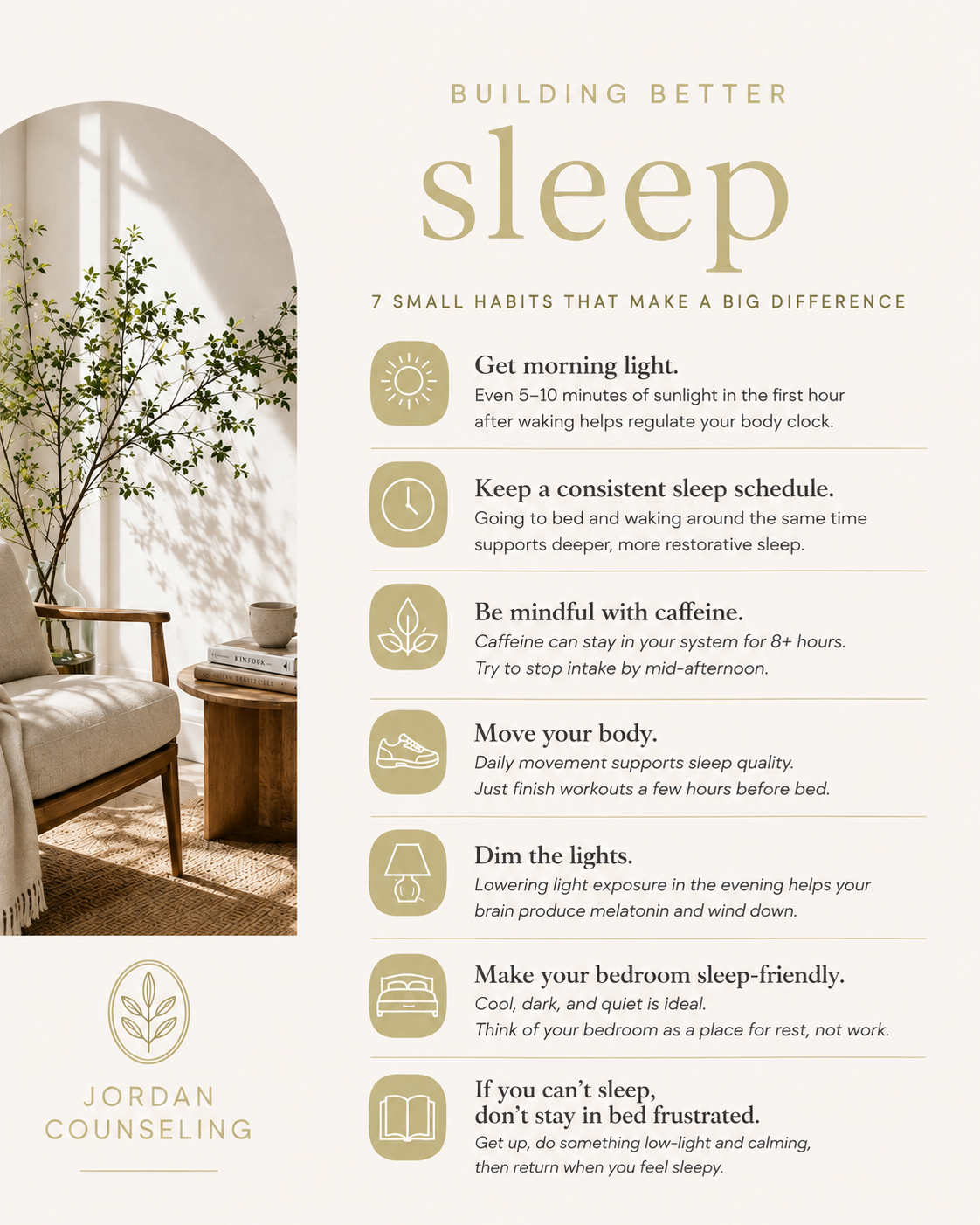
1. Start the day with sunlight.
This is one that has personally helped me a lot. It’s easy to incorporate, and aside from the benefits below, is really the only “meditative” time I get throughout the day. Getting outside within the first hour after waking is one of the most effective ways to regulate our circadian rhythm, no need to stare at the sun, just face the general direction of the morning light. This sends a signal to our brain that it's time to be awake, helping increase alertness during the day while also setting the internal timer for melatonin, the hormone that promotes sleep, to be released later in the evening. Even 5-10 minutes on a sunny day (or 15-20 minutes when it's cloudy) can make a difference. Consistent morning light exposure has also been linked to improved mood, reduced stress, and lower symptoms of anxiety and depression, likely because a well-regulated circadian rhythm supports healthier cortisol patterns, emotional regulation, and more restorative sleep.
2. Keep a consistent sleep and wake time.
This one can be really hard with busy schedules. But the brain thrives on predictability. Going to bed and waking up at similar times each day strengthens our internal body clock, making it easier to fall asleep naturally and wake feeling more refreshed. Sleeping in significantly on weekends can create a "social jet lag" effect, making Monday mornings feel like we've traveled across time zones. Beyond improving sleep, maintaining a consistent sleep schedule has also been associated with better emotional regulation and lower symptoms of anxiety and depression, as our brain and body function best when they can rely on a predictable daily rhythm.
3. Be mindful of caffeine.
Read before freaking out here - I’m not giving up coffee and neither should you! But caffeine doesn't just help us feel awake - it blocks adenosine, a chemical that naturally builds throughout the day to create "sleep pressure." Even if we are a “can fall asleep after an afternoon coffee” person, caffeine may reduce deep sleep without us realizing it. Most people benefit from stopping caffeine at least 8-10 hours before bedtime, though some people metabolize it more slowly and may need an even earlier cutoff. While excessive caffeine can disrupt sleep, research shows that moderate intake can safely enhance focus, alertness, and cognitive performance for most healthy adults. Don’t cut it out,just be aware of sensitivity and timing!
4. Move the body every day.
Regular movement is linked to better sleep quality, reduced stress, and improved mood. Exercise also helps regulate hormones and body temperature, both of which influence sleep. This doesn’t require an intense workout - a daily walk, yoga, or stretching all count. If vigorous exercise leaves you feeling energized, try finishing it a few hours before bedtime.
5. Dim the lights and put our phones away before bed.
Our brains evolved to respond to light. As evening approaches, lowering the lights helps signal that it's time to transition toward rest. Bright overhead lighting and screens, especially when they're stimulating, can delay the brain's natural preparation for sleep. Research suggests that the blue-enriched light emitted by phones, tablets, and other electronic devices can suppress melatonin, the hormone that helps regulate our sleep-wake cycle, making it harder to fall asleep. Beyond the light itself, scrolling through social media, checking emails, watching videos, or reading emotionally charged content keeps our brains cognitively and emotionally engaged when they should be slowing down.
Whenever possible, phones away for at least 30-60 minutes before bed helps. If that's not realistic, reducing screen brightness, using night mode, or avoiding particularly stimulating content is a useful practice. Creating a simple wind-down routine with softer lighting, reading a physical book, gentle stretching, journaling, or calming music helps cue both our brain and body that the day is ending.
6. Make the bedroom a place our brain associates with sleep.
A cool, dark, and quiet room supports deeper, more restorative sleep by reducing environmental disruptions and helping our core body temperature naturally decline. If possible, reserve your bed primarily for sleep (and intimacy), rather than working or scrolling, so your brain continues to associate your bed with rest instead of wakefulness.
7. If you can't sleep, don't stay in bed frustrated.
Lying awake worrying about sleep often teaches the brain that the bed is a place for stress instead of rest. It is recommended that if we've been awake for about 20-30 minutes, getting up and doing something quiet in dim lighting (no scrolling) - like reading a few pages of a book, practicing gentle breathing, or listening to calming music/sounds provides better support. This strategy comes from Cognitive Behavioral Therapy for Insomnia (CBT-I), the gold-standard treatment for chronic insomnia.
Sleep issues can be incredibly frustrating.
Anxiety, stress, depression, and mood disorders can all be significantly affected by poor sleep. Even just choosing one or two of these habits can create meaningful changes over time. And if sleep continues to be a struggle, discuss potential underlying causes with your medical practitioner. Addressing those root causes is an important part of healing.
Sleep health supports whole mind and body wellness.
Helpful Resources
Apps:
Insight Timer (Free with optional premium)
One of the largest libraries of guided meditations, sleep stories, breathing exercises, and relaxing music. Great if you're new to meditation or looking for a short wind-down routine before bed.CBT-i Coach (Free)
Developed by the U.S. Department of Veterans Affairs in collaboration with Stanford School of Medicine and the U.S. Department of Defense. This app is based on Cognitive Behavioral Therapy for Insomnia (CBT-I). It includes sleep tracking, education, relaxation exercises, and tools to help improve sleep habits.Calm
Known for guided sleep meditations, sleep stories, breathing exercises, and relaxing soundscapes. A good option for building a calming bedtime routine.
Podcasts & Videos:
Huberman Lab - Sleep Toolkit: Tools for Optimizing Sleep & Sleep-Wake Timing
A comprehensive episode covering circadian rhythms, sunlight exposure, caffeine timing, temperature, exercise, and other evidence-based sleep strategies.
https://www.hubermanlab.com/episode/sleep-toolkit-tools-for-optimizing-sleep-and-sleep-wake-timingHuberman Lab Essentials - Sleep Toolkit for Optimizing Sleep & Sleep-Wake Timing
A shorter, condensed version highlighting the key takeaways.
https://www.hubermanlab.com/episode/essentials-sleep-toolkit-for-optimizing-sleep-and-sleep-wake-timingThe Matt Walker Podcast
Official podcast page featuring short, research-based episodes on sleep science.
https://themattwalkerpodcast.buzzsprout.comTED Talk - "Sleep Is Your Superpower" by Dr. Matt Walker
One of the most popular TED Talks on sleep, explaining why sleep is essential for mental health, memory, learning, and longevity.
https://www.ted.com/talks/matt_walker_sleep_is_your_superpower
References
American Academy of Sleep Medicine. (2021). Healthy sleep habits. https://aasm.org/resources/factsheets/sleep-hygiene.pdf
Centers for Disease Control and Prevention. (2024). Sleep and sleep disorders. https://www.cdc.gov/sleep/
Edinger, J. D., Arnedt, J. T., Bertisch, S. M., et al. (2021). Behavioral and psychological treatments for chronic insomnia disorder in adults: An American Academy of Sleep Medicine clinical practice guideline. Journal of Clinical Sleep Medicine, 17(2), 255–262. https://doi.org/10.5664/jcsm.8986
Huberman, A. (Host). (2022, August 8). Sleep toolkit: Tools for optimizing sleep & sleep-wake timing (No. 84) [Audio podcast episode]. Huberman Lab. https://www.hubermanlab.com/episode/sleep-toolkit-tools-for-optimizing-sleep-and-sleep-wake-timing
Huberman, A. (Host). (2024). Essentials: Sleep toolkit for optimizing sleep & sleep-wake timing [Audio podcast episode]. Huberman Lab. https://www.hubermanlab.com/episode/essentials-sleep-toolkit-for-optimizing-sleep-and-sleep-wake-timing
Irish, L. A., Kline, C. E., Gunn, H. E., Buysse, D. J., & Hall, M. H. (2015). The role of sleep hygiene in promoting public health: A review of empirical evidence. Sleep Medicine Reviews, 22, 23–36. https://doi.org/10.1016/j.smrv.2014.10.001
National Heart, Lung, and Blood Institute. (n.d.). Healthy sleep habits. U.S. Department of Health and Human Services. https://www.nhlbi.nih.gov/health/sleep/healthy-sleep-habits
