Whether it's walking into a tense meeting and immediately feeling anxious, leaving a family gathering emotionally drained, or noticing your mood shift simply because someone close to you is struggling, some of us feel like sponges, feeling as though we automatically absorb the emotions of those around us. Or as a millennial’s parent would say “you’re just too sensitive”.
Ring a bell?
Some may refer to this as feeling "highly sensitive." Others identify as "empaths." Or some of us wonder why experiences seem to affect or impact us much more intensely.
Research suggests that some people naturally process social and emotional information more deeply than others. Combined with empathy, awareness, life experiences, and the way our own adaptation system responds to stress, this can create the feeling that we're carrying emotions that aren't entirely our own. Like we’re not feeling enough of our own already, damn!
Understanding the why can help us move from feeling overwhelmed by our sensitivity, to learning how to appreciate this part of ourselves, and manage the experience when it happens.
What Does It Mean to Be Highly Sensitive?
Highly sensitive people aren't simply "more emotional."
Research on Sensory Processing Sensitivity (SPS), first described by psychologist Dr. Elaine Aron, suggests that approximately 15–20% of people naturally process environmental and social information more deeply than others. They tend to notice subtle changes in facial expressions, tone of voice, body language, and emotional nuance that others may overlook. This depth of processing often contributes to strengths like empathy, creativity, intuition, and insight, but it also means emotionally demanding environments require more mental and physiological resources.
Sensitivity isn't about having less emotional capacity. It may simply mean our nervous system is using more of that capacity taking in, processing, and making meaning of the world around you. By the end of the day, our emotional "tank" may feel emptier, because our brain has simply been doing more work.
It's also important to remember that noticing more cues does not automatically mean interpreting them more accurately. Even people who are highly sensitive can sometimes fall into cognitive traps such as projection (attributing our own feelings or expectations to others), mind reading (assuming we know what someone else is thinking without enough evidence), or over-identification (becoming so immersed in another person's emotions or our own interpretations that we lose objectivity). Subtle cues or relating to being an empath is a helpful skill that provides valuable information, but needs to run through an anchored check ourselves filter as well.
Why Does It Feel Like We’re Carrying Everyone Else's Emotions?
One explanation comes from a psychological phenomenon called emotional contagion.
Emotional contagion refers to our natural tendency to "catch" the emotions of those around us. Without realizing it, our brains are constantly reading facial expressions, body language, vocal tone, and countless other social cues to determine whether an interaction feels safe, stressful, joyful, or threatening.
For many people, these emotional shifts are subtle and temporary. But individuals with greater sensory sensitivity or stronger affective empathy often notice and process these cues more deeply. The result can feel as though another person's emotions have become our own, even when we don’t want them to.
This doesn't mean we're literally absorbing someone else's feelings or energy. Rather, our awareness/adaptation system may be exceptionally skilled at detecting emotional information - and our brain is working hard to make sense of it.
Emotional contagion explains why we may begin feeling what others feel. The question then becomes: How do we stay connected to others without losing connection to ourselves? Or in simple terms, how do we shake that shit off?
One helpful way to understand this is through the lens of the Window of Tolerance, a concept developed by psychiatrist Dr. Dan Siegel.
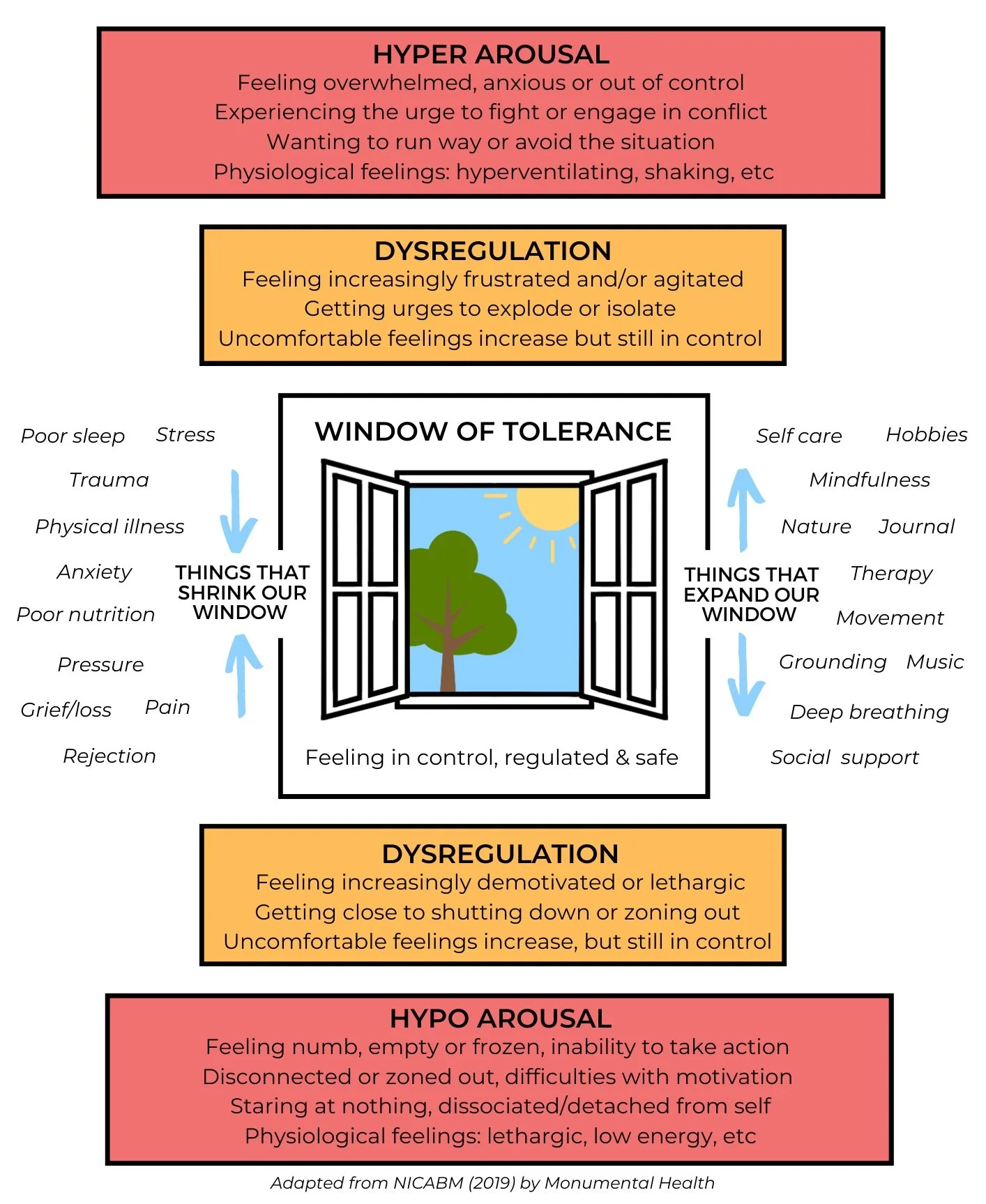
Think of your Window of Tolerance as the range in which your resource or capacity system can stay chill, flexible, and connected. Within this window, we're able to think clearly, manage emotions, remain curious, and respond intentionally - even when things feel challenging.
Every emotionally charged interaction asks something of us. For people who naturally process emotional information more deeply, those interactions may require more energy than they realize. Over time, enough emotional demands can push us outside our window, leaving us feeling emotionally flooded, anxious, and reactive - or, on the other end of the spectrum, emotionally numb, exhausted, or disconnected.
Rather than meaning something is wrong with us, these responses often signal that we have reached our current capacity. Time to tap out.
Staying Connected Without Losing Self
Being deeply affected by others isn't something that needs fixing.
In fact, sensitivity often allows people to become incredible partners, parents, friends, caregivers, leaders, and therapists. They notice what others miss. They offer compassion naturally. They create spaces where people feel understood.
The challenge isn't feeling deeply.
The challenge is remaining connected to ourselves while staying open to others, and allowing what is theirs to stay in the other lane.
This is where differentiation becomes so valuable.
Differentiation is the ability to remain grounded in our own thoughts, emotions, values, and needs while staying emotionally connected to another person. Read more about this crazy important skill: HERE. The more secure we become in our own internal experience, the easier it becomes to notice when we're resonating with someone else's emotions instead of becoming consumed by them.
In other words, emotional contagion explains why we may begin feeling what others feel. Differentiation gives us the skills to recognize it without losing ourselves in it.
Creating Space Between Feeling and Reacting
While emotional contagion often happens automatically, how we respond is within our control.
In The Good Life, Drs. Robert Waldinger and Marc Schulz describe a simple framework called WISER that helps us create a pause between experiencing an emotion and reacting to it.
When you notice yourself becoming emotionally activated, try asking yourself:
Watch: What am I feeling right now? What do I notice in my body?
Interpret: What might be contributing to this? Is this emotion mine, someone else's, or a combination of both?
Select: What response aligns with my values rather than my immediate impulse?
Engage: Respond intentionally instead of automatically.
Reflect: What helped me stay grounded? What can I carry forward into future situations?
For someone who is naturally more sensitive, WISER isn't about becoming less empathic. It's about creating enough space between what we feel and how we respond that we can remain compassionate without becoming overwhelmed.
A Few Questions to Reflect On
When someone close to you is anxious, do you begin feeling anxious too?
After spending time with emotionally intense people, how long does it take you to feel like yourself again?
Can you identify what you're feeling before asking how everyone else is doing?
Do you often feel responsible for improving another person's emotional state?
What helps you reconnect with yourself after emotionally demanding interactions?
We need sensitive people, especially now. It’s important as a sensitive person to find ways to stay anchored in ourselves, allowing that sensitivity to become a source of wisdom, instead of burnout and overwhelm.
If you've often felt emotionally overwhelmed, highly affected by those around you, or unsure where your emotions end and someone else's begin, counseling is a great support to help us better understand our own brain/body’s innate adaptation go-to’s, strengthen our individual differentiation, and build confidence in balancing remaining compassionate without becoming consumed by emotions or energies around us.
Resources:
Aron, E. N., & Aron, A. (1997). Sensory-processing sensitivity and its relation to introversion and emotionality.Journal of Personality and Social Psychology, 73(2), 345–368.
Aron, E. N. (2010). Psychotherapy and the Highly Sensitive Person. Routledge.
Bowen, M. (1978). Family Therapy in Clinical Practice. Jason Aronson.
Decety, J., & Jackson, P. L. (2004). The functional architecture of human empathy.Behavioral and Cognitive Neuroscience Reviews, 3(2), 71–100.
Gross, J. J. (1998). The emerging field of emotion regulation: An integrative review.Review of General Psychology, 2(3), 271–299.
Hatfield, E., Cacioppo, J. T., & Rapson, R. L. (1994). Emotional Contagion. Cambridge University Press.
Lionetti, F., Aron, E. N., Aron, A., et al. (2018). Dandelions, tulips and orchids: Evidence for the existence of low-sensitive, medium-sensitive and high-sensitive individuals.Translational Psychiatry, 8, 24.
Ogden, P., Minton, K., & Pain, C. (2006). Trauma and the Body. W. W. Norton.
Singer, T., & Lamm, C. (2009). The social neuroscience of empathy.Annals of the New York Academy of Sciences, 1156, 81–96.
Waldinger, R., & Schulz, M. (2023). The Good Life: Lessons from the World's Longest Scientific Study of Happiness. Simon & Schuster.
